Beyond the Formula Sheet: Why Understanding Calculus Theorems Matters More Than Memorizing Them

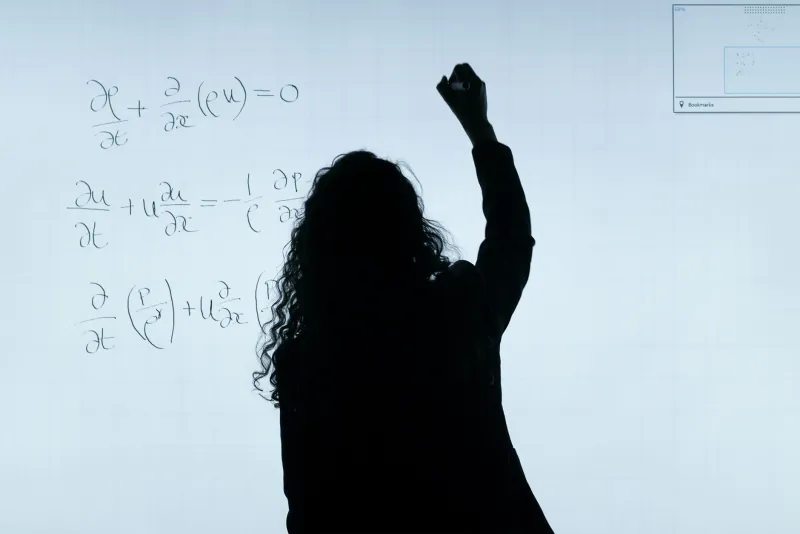
Photo: Amuzujoe, CC BY-SA 4.0, via Wikimedia Commons
There is a ritual familiar to nearly every calculus student in the United States. The night before an exam, you open your notebook or pull up a formula sheet and commit a set of theorem statements to memory. The Fundamental Theorem of Calculus. The Mean Value Theorem. Rolle's Theorem. The Intermediate Value Theorem. You repeat the statements until they feel solid, walk into the exam, and then—somewhere between reading the problem and writing the first line—the confidence evaporates.
The theorem is there in your memory, but you cannot determine whether it applies. You cannot tell what it is actually telling you about the function in front of you. You write something down, hope it resembles what the grader wants to see, and move on.
This experience is not a sign of insufficient studying. It is the predictable consequence of a particular approach to calculus instruction that prioritizes the what of a theorem over the why.
The Memorization Default and Where It Comes From
US calculus courses, particularly at the high school AP level and in large introductory college sections, operate under significant time pressure. Covering limits, derivatives, integrals, and applications within a single academic year leaves instructors with limited room to linger on proof structure or conceptual motivation. The practical result is that theorems are often introduced as tools: here is the statement, here is the condition checklist, here is how you apply it to a problem.
This approach is not without merit. Students do need to know how to apply theorems under exam conditions. The problem arises when application becomes the only goal, and the theorem's meaning—what it is actually asserting about the behavior of functions—is never made explicit.
A student who has only memorized the Mean Value Theorem as a formula will struggle when asked to explain what it guarantees or to identify a scenario in which its conclusion would fail. They have a tool they cannot fully use, because they do not understand what the tool was designed to do.
What Theorems Are Actually Doing
Calculus theorems are not arbitrary rules handed down from an authority. They are precise descriptions of how continuous and differentiable functions must behave under specific conditions. Each theorem answers a question that mathematicians found genuinely important.
The Intermediate Value Theorem answers: if a continuous function takes two values, must it take every value in between? The answer—yes—is not obvious until you think carefully about what continuity means geometrically. The theorem is, at its core, a formalization of the intuition that a continuous curve cannot jump.
The Mean Value Theorem answers: if a function is well-behaved on an interval, must there be at least one point where the instantaneous rate of change equals the average rate of change over that interval? Again, the answer is yes, and the geometric picture—a secant line and a parallel tangent line—makes this feel almost inevitable once you see it.
The Fundamental Theorem of Calculus answers: what is the relationship between differentiation and integration? The answer is that they are inverse operations, and the theorem is the formal proof of that relationship. It is arguably the single most important result in introductory calculus, connecting two concepts that students often treat as entirely separate subjects.
When students understand what question each theorem answers, they gain the ability to recognize when that question is relevant—which is precisely what exam problems require.
A Case Study in Conceptual Transformation
Consider a student who enters a second-semester calculus course having passed the first semester through diligent memorization. She knows the statements of the major theorems. She can reproduce them on demand. But when asked on a practice exam to use the Mean Value Theorem to argue that a particular equation has a solution, she stalls completely. The problem does not look like the problems she practiced. There is no obvious checklist to run through.
After working with a tutor who takes a conceptual-first approach, she revisits the Mean Value Theorem not as a formula but as a story: a function travels from point A to point B, and somewhere on that journey, it must have been moving at exactly the average speed. She draws the picture. She articulates what the theorem is claiming in plain language. She then returns to the exam problem and recognizes it immediately as a question about whether a certain average rate of change must be achieved.
This kind of transformation is not unusual. Students who rebuild their understanding of theorems at the conceptual level routinely report that exam problems become more readable—not because the problems get easier, but because the student now understands what the problem is asking.
Practical Strategies for Rebuilding Your Relationship with Theorems
If you recognize yourself in the memorization-first pattern, the following strategies can help you develop a more durable understanding.
Restate every theorem in plain language. Before worrying about formal notation, write out what the theorem is claiming in ordinary English. If you cannot do this, you do not yet understand the theorem well enough to apply it reliably.
Draw the picture. Most theorems in introductory calculus have a clear geometric interpretation. Sketch it. Label the parts that correspond to the theorem's hypotheses and the parts that correspond to its conclusion. The visual representation often makes the logical structure far more transparent than the symbolic statement.
Examine the hypotheses critically. Ask yourself: what happens if one of the conditions is removed? Constructing a counterexample for a modified version of a theorem is one of the most effective ways to understand why each condition is necessary. This also prepares you for a category of exam question that specifically tests whether you know when a theorem does not apply.
Connect theorems to each other. Calculus theorems do not exist in isolation. Rolle's Theorem is a special case of the Mean Value Theorem. The Fundamental Theorem of Calculus depends on continuity, which connects it to the Intermediate Value Theorem. Mapping these relationships builds a coherent conceptual framework rather than a disconnected list of facts.
Read a proof—at least once. You do not need to reproduce proofs under exam conditions in most US calculus courses. But reading through a proof of the Fundamental Theorem of Calculus, even if slowly and with assistance, gives you insight into why the result is true. That insight tends to stick in a way that memorized statements do not.
The Long-Term Payoff
Students who invest in conceptual understanding of theorems do not just perform better on exams—though the evidence suggests they do. They also find subsequent mathematics courses significantly more accessible. Differential equations, real analysis, and multivariable calculus all build on the foundations laid in introductory calculus. Students who understand those foundations as a coherent structure, rather than a collection of memorized rules, are far better positioned to extend their knowledge.
The formula sheet is not the enemy. But it should be a reference, not a substitute for understanding. When you know what a theorem means—truly know it, not just recognize its symbolic form—you stop needing to guess whether it applies. The theorem tells you.