More Hours, Less Progress: The Diminishing Returns of Overloading Your Calculus Study Schedule
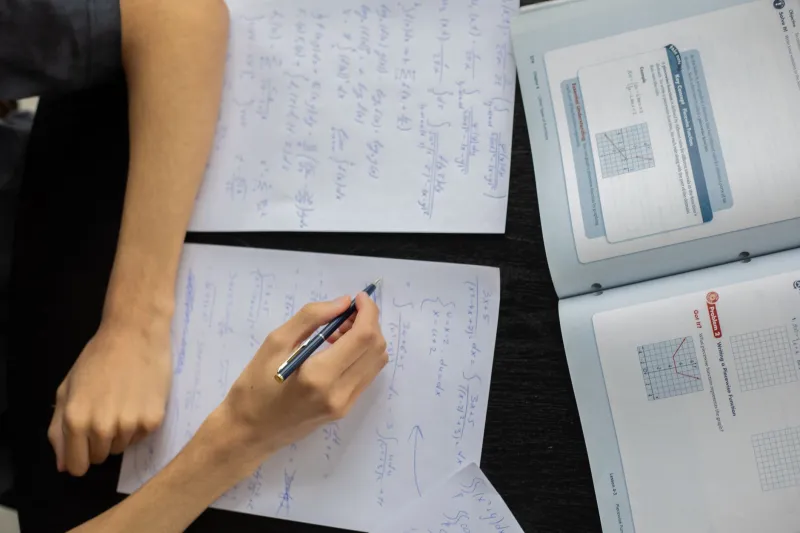
There is a particular kind of frustration that calculus students know well: the feeling of having spent an entire weekend reviewing material, only to sit down for a quiz on Monday and find that nothing seems to have stuck. The hours were logged. The textbook was open. The problems were attempted. And yet, the understanding simply did not deepen in proportion to the time invested.
This is not a motivation problem. It is not a talent problem. It is, ironically, a calculus problem — one that students are already equipped to understand, if they recognize it.
When the Marginal Gain Approaches Zero
In calculus, you learn that a function can increase steadily for a while, then begin to level off as its rate of change — its derivative — approaches zero. Consider a simple increasing function that grows steeply at first, then flattens into a near-horizontal asymptote. Adding more input beyond a certain threshold yields almost no additional output.
Now consider your own study sessions through the same lens. Early in a focused review block, comprehension increases meaningfully with each passing hour. You are making real connections, solidifying new procedures, and building genuine fluency. But at some point — and this point arrives much sooner than most students expect — the marginal gain per hour of additional study shrinks dramatically. You are still putting in input. The output has simply stopped responding.
This is not a metaphor borrowed loosely from mathematics. It reflects real cognitive constraints. The brain has a limited capacity for active encoding within a single sitting. Once working memory is saturated and mental fatigue sets in, continued exposure to material shifts from productive learning to passive consumption. You are reading, but not processing. You are going through the motions of studying while the mechanisms that actually build understanding have quietly gone offline.
The Passive Review Trap
One of the most common patterns among struggling calculus students is what might be called the passive review loop. A student re-reads their notes, flips back through textbook examples, and watches solution videos — all of which feel productive because they involve engagement with the material. But passive review, particularly when pursued for extended periods, creates a false sense of familiarity without building the retrieval strength that real understanding requires.
Familiarity is not mastery. Recognizing a problem type when you see it solved in front of you is categorically different from being able to construct a solution independently under exam conditions. When a student spends three hours passively reviewing integration techniques, they often emerge feeling more confident — but that confidence is, in many cases, a cognitive illusion produced by repeated exposure rather than genuine competence.
The distinction matters enormously in calculus, where problems rarely present themselves in the exact form a student encountered during review. Passive familiarity breaks down the moment the context shifts even slightly.
Strategic Breaks Are Not Wasted Time
Neuroscience research on memory consolidation offers a clear message that runs counter to the instincts of most high-achieving students: the brain does a significant portion of its learning work when it is not actively studying. During rest periods — and especially during sleep — the hippocampus replays recently encoded information and transfers it into longer-term storage. This process, known as consolidation, cannot be rushed or replaced by additional study hours.
For calculus students, this means that a well-structured two-hour session followed by a genuine break will, in most cases, produce stronger retention than a four-hour session with no interruption. The break is not a concession to laziness. It is a required component of the learning process.
Practical application: build deliberate stopping points into your study schedule. After working through a set of related-rates problems or practicing u-substitution, step away for at least twenty minutes before returning to the material. Do something entirely unrelated. When you come back, you will often find that concepts which felt slippery before the break have become noticeably clearer — not because you studied more, but because your brain was given the time it needed to do its consolidation work.
Identifying the Point of Diminishing Returns in Your Own Sessions
Learning to recognize when a study session has passed its point of productive return is a practical skill, and one worth developing deliberately. Several signs indicate that additional hours are unlikely to deepen understanding:
-
Errors begin repeating. If you are making the same algebraic mistake on a chain rule problem for the third time in a row, continued practice in that session is unlikely to correct it. The error has become entrenched in your current cognitive state. Sleep, and a fresh attempt the following morning, will be more effective than grinding through ten more repetitions.
-
Comprehension feels circular. When re-reading a theorem or worked example produces the same level of confusion it did thirty minutes ago, you have reached a saturation point. More reading will not resolve the confusion; a different approach — a different resource, a different explanation, or a conversation with a tutor — is what is actually needed.
-
Motivation collapses suddenly. A sharp, unexpected drop in willingness to engage with the material often signals genuine cognitive fatigue rather than ordinary distraction. Pushing through this state tends to produce low-quality work that can actually reinforce incorrect procedures.
Restructuring Your Approach
The alternative to maximizing study hours is not studying less — it is studying with greater intentionality about what each session is designed to accomplish. A focused forty-five-minute block built around active problem-solving, where you are generating solutions rather than observing them, will consistently outperform two hours of passive review.
Consider organizing your calculus study time around specific, testable objectives. Instead of "review Chapter 4," a more effective session goal might be "complete six optimization problems from scratch without consulting notes, then identify any step where I got stuck." That specificity forces active engagement, surfaces genuine gaps in understanding, and gives you actionable information about where to direct your next session.
Spacing your study sessions across multiple days — rather than consolidating them into a single extended block — also leverages the consolidation process described above. Three one-hour sessions spread across three days will, for most students, produce meaningfully better retention than a single three-hour session the night before an exam.
The Deeper Lesson
There is something fitting about using calculus concepts to understand how calculus itself should be studied. The same analytical framework that helps you find the maximum value of a function — identifying where the rate of change shifts from positive to negative — applies directly to the question of how much study time is actually beneficial.
More is not always more. At some point, the function turns. Recognizing that inflection point in your own learning, and responding to it strategically rather than pushing blindly past it, is one of the most valuable skills a calculus student can develop. Not because it makes studying easier, but because it makes studying work.