Thinking Backwards: How Adopting an Inverse Mindset Transforms Your Approach to Integration

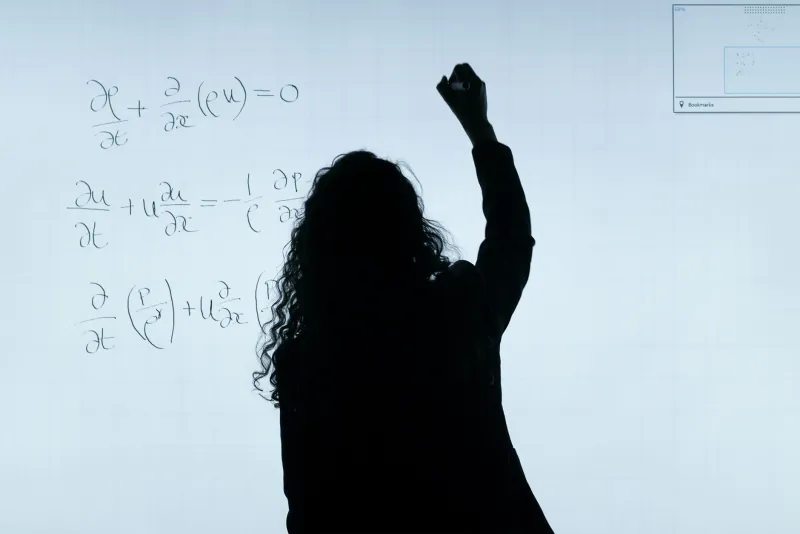
Photo: student thinking backwards at chalkboard with calculus equations, via thumbs.dreamstime.com
There is a moment familiar to nearly every calculus student in America. You have spent weeks mastering differentiation — finding derivatives with growing confidence, applying the power rule, the product rule, the chain rule — and then your instructor introduces integration. Suddenly, the floor drops out. The mechanics look similar, the notation is unfamiliar, and your carefully developed instincts seem to stop working.
The frustration is real, but the source of it is often misdiagnosed. The struggle with integration is rarely about computational ability. More often, it is a cognitive mismatch. You are attempting to solve an inverse problem using a forward-thinking brain.
What Differentiation Trained You to Do
Differentiation is, in a fundamental sense, a process of transformation. You begin with a function — something concrete and known — and you apply a set of rules to produce something new. The chain rule, the quotient rule, implicit differentiation: each technique is a recipe that takes an input and reliably produces an output. The process moves in one direction.
This forward motion is intuitive. Human cognition naturally gravitates toward causation and sequence. You do something, and a result follows. Months of practice with derivatives reinforce this directionality until it becomes automatic.
Integration dismantles that automaticity. Rather than transforming a known function, you are presented with what is essentially a clue — a derivative — and asked to reconstruct the original. The question is no longer "what does this function become?" but "what function would have produced this?"
That is a profoundly different cognitive task, and recognizing the difference is the first step toward genuine integration fluency.
The Inverse Problem in Practice
Consider the expression ∫ 3x² dx. A student conditioned by differentiation might scan for a rule to apply and feel uncertain when nothing clicks immediately. But a student who has internalized the inverse mindset reads this expression differently. They ask: which function, when differentiated, yields 3x²?
Recalling that the derivative of x³ is 3x², the answer becomes transparent: the antiderivative is x³ + C. The constant of integration, far from being a trivial footnote, reflects something conceptually important — the original function could have included any constant term, and differentiation would have erased it. Integration acknowledges that lost information.
This small example illustrates the larger principle. Integration is detective work. You are reconstructing a scene from its aftermath. Every technique in your integration toolkit — substitution, integration by parts, partial fractions — is ultimately a strategy for making that reconstruction more tractable.
Rewiring Your Instincts: Three Practical Strategies
1. Build a Derivative-Antiderivative Vocabulary
One of the most effective ways to develop integration fluency is to stop treating derivatives and antiderivatives as separate lists and start studying them as paired relationships. For every derivative rule you know, articulate its inverse explicitly.
For example, rather than simply knowing that d/dx[sin(x)] = cos(x), train yourself to simultaneously recognize that ∫ cos(x) dx = sin(x) + C. Create a two-column reference sheet — not to memorize in isolation, but to build the habit of reading calculus relationships bidirectionally. Over time, this dual awareness becomes second nature.
2. Practice Recognition Before Computation
Before you attempt to evaluate any integral, spend a moment identifying its structure. Ask yourself: does this resemble the result of a chain rule application? A product rule? Is there a composition hidden inside this expression?
This recognition phase is where integration success is often won or lost. Students who rush directly into computation frequently apply techniques to integrals that do not suit them, wasting time and building frustration. Slowing down to classify the integral — even briefly — activates the inverse mindset and points you toward the right approach.
3. Verify Through Differentiation
Every antiderivative you compute can be checked by differentiating your answer. This verification step is not merely a safety net; it is a powerful cognitive reinforcement tool. When you differentiate your result and recover the original integrand, you are directly experiencing the inverse relationship between the two operations.
Make this verification a non-negotiable habit during your practice sessions, even when you feel confident. The repetition of confirming that differentiation undoes your integration — and vice versa — gradually rewires the way you perceive both operations as a unified, bidirectional system.
Why the Constant of Integration Is a Conceptual Anchor
Many students treat the + C at the end of an indefinite integral as a bureaucratic requirement — something the instructor insists upon but that carries little meaning. In reality, it encodes a crucial conceptual truth.
When you differentiate a function, any constant term vanishes. The derivative of x³ + 7 is identical to the derivative of x³ + 100. Integration, working backwards, cannot recover what was lost. The constant of integration is the mathematical acknowledgment of that irreversible information loss — a reminder that the antiderivative is not a single function but an entire family of functions, each differing by a constant.
Understanding this point shifts the + C from an afterthought to a conceptual anchor. It reinforces the inverse nature of the operation and deepens your appreciation for why definite integration — which introduces limits and eliminates the constant — represents a more specific, answerable question.
The Long Game: Building Integration Intuition
Developing genuine integration fluency takes longer than mastering differentiation, and that timeline is worth accepting honestly. The inverse mindset does not install itself overnight. It is built through repeated exposure, deliberate pattern recognition, and the willingness to sit with uncertainty while working backwards from a clue toward an answer.
US calculus courses — whether at the high school AP level or in college — tend to move quickly through integration, leaving students with procedural exposure but insufficient time for conceptual consolidation. Supplementing your coursework with focused, unhurried practice on recognizing integral structures will pay dividends not just on exams, but in every subsequent course that builds on this foundation.
Integration is not harder than differentiation. It is different. Once you internalize that difference — once you genuinely embrace the backwards perspective — the subject opens up in ways that no formula sheet can replicate.